
I’ve fallen down a bit of a kitchen rabbit hole recently while researching for a project and, I’ve got to admit, it’s really piqued my interest.
The ‘invisible kitchen’, where some or all of the working parts can be concealed behind cabinetry, is definitely gaining ground, but there’s also a growing appetite for freestanding kitchens, moveable islands and more furniture-led designs. Then there’s the ‘soft kitchen’, which is all about bringing more of the warmth and character we’d normally associate with living spaces into the kitchen.
The more I read, the more I’ve started to wonder: are we actually falling out of love with the traditional kitchen as we know it?
Not kitchens themselves. We still need somewhere to cook, make coffee, unload the shopping, feed the children and entertain friends. But there is definitely something interesting happening, not so much with what the kitchen does, but with how we use it and how we want to feel in that space.
Houzz’s latest UK research has seen searches for moveable kitchen islands increase more than ninefold, freestanding kitchens rise 3.5 times and appliance garages increase 453%, alongside growing interest in walk-in pantries, coffee stations and kitchen bars. At first glance, those things pull in opposite directions: we’re becoming more interested in kitchens we can move around, while simultaneously becoming more interested in kitchens we can shut away. Which doesn’t make much sense, except perhaps it does.
Maybe its about having options //
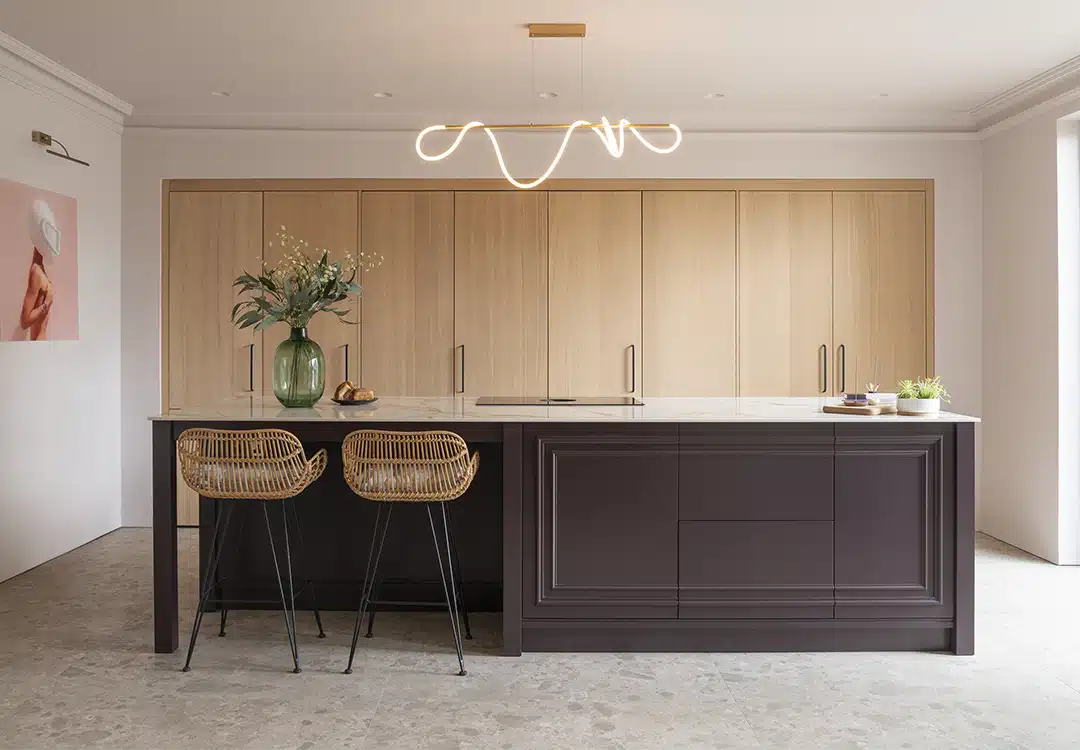
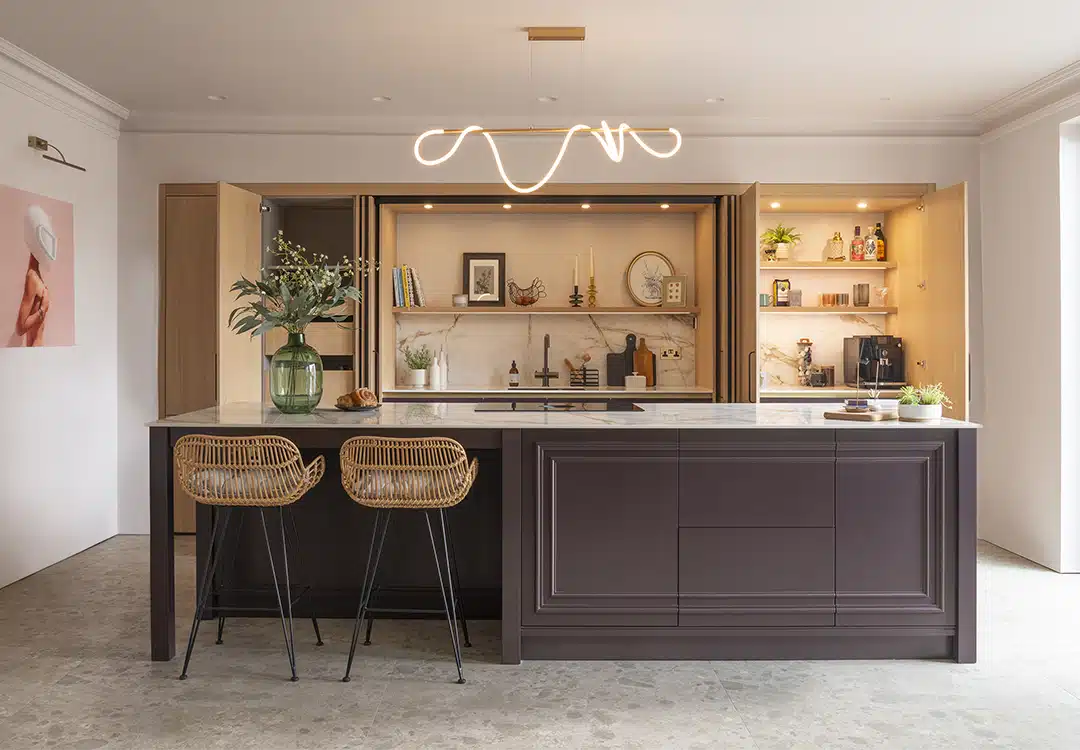
I’m not convinced most of us actually want our kitchens to disappear. We designed a kitchen a few years ago where the brief was pretty much exactly that: the clients didn’t want their big open-plan living space to feel like a kitchen. Almost the entire working run – fridge and freezer, ovens, sink, dishwasher, storage and breakfast/bar area – could be concealed behind large veneered pocket doors.
There were some very practical reasons for that. Mess was one; cats were another. But the bigger reason was how they wanted the room to feel. It was the main hub of their home and they wanted it to feel warm, inviting, relaxed and beautiful, rather than like one enormous functional kitchen. The funny thing is, we spent just as much time making sure it looked beautiful when the doors were open, because people leave doors open. We certainly do.
We have cabinetry at home that was specifically designed to be closed because it houses our glassware, which gets greasy if it’s exposed to the kitchen, but still, it regularly gets left open. We’re human; opening and closing a pocket door every time you want something eventually becomes one job too many. A breakfast station is an even better example because you don’t just reach in, grab something and close it again. You’re using the toaster, making coffee, waiting for the toaster, making another coffee – you’re actually spending time with that cupboard open.
So perhaps the interesting bit about concealed kitchens isn’t the concealment at all, but the option. Sometimes you want the working parts of your kitchen visible and sometimes you don’t, and if something is going to spend half its life open, it still needs to look great when it is. Unless it’s genuinely just a store cupboard, of course. I’m not suggesting we all need beautifully veneered interiors behind the cupboard containing the spare kitchen roll; sometimes a cupboard can just be a cupboard.
What about the Island? //
I have slightly mixed feelings about kitchen islands. When the space is right for one they can be brilliant – more preparation space, more storage and, often, a really sociable place to sit. What I don’t like, however, is the assumption that a great kitchen can’t actually be a great kitchen without one, regardless of whether the room really wants it. I’d much rather see an island properly designed into a space than the whole space compromised around the insistence of having one.
“Maybe we’re not falling out of love with fitted kitchens. Maybe we’re falling out of love with kitchens that look too fitted.”
Interestingly, it’s also the part of a kitchen where I most like the idea of freestanding furniture. There’s something charming and characterful about an island that feels like an individual piece of furniture rather than another run of matching kitchen cabinets. You can borrow that furniture language without giving up all the practical benefits of fitted cabinetry.
So what is a ‘soft kitchen’? //
This is where I’ve had to check myself a little. I spend an enormous amount of time looking at interiors and, inevitably, I’ve developed quite strong opinions about what I personally think looks good – it’s an occupational hazard. But I’ve also designed projects that, if I’m completely truthful, aren’t necessarily what I would describe as beautiful. I wouldn’t choose the colours or the particular style, or put it in my own house – and yet they’re still good designs, because I wasn’t designing them for me.
They work brilliantly for the people who live with them. They suit their tastes, routines, needs, budget and their home, and that’s made me think quite a lot about the difference between taste and design. Good design isn’t necessarily the kitchen that gets the most saves on Instagram; sometimes it’s the kitchen that makes one particular family’s life considerably better.
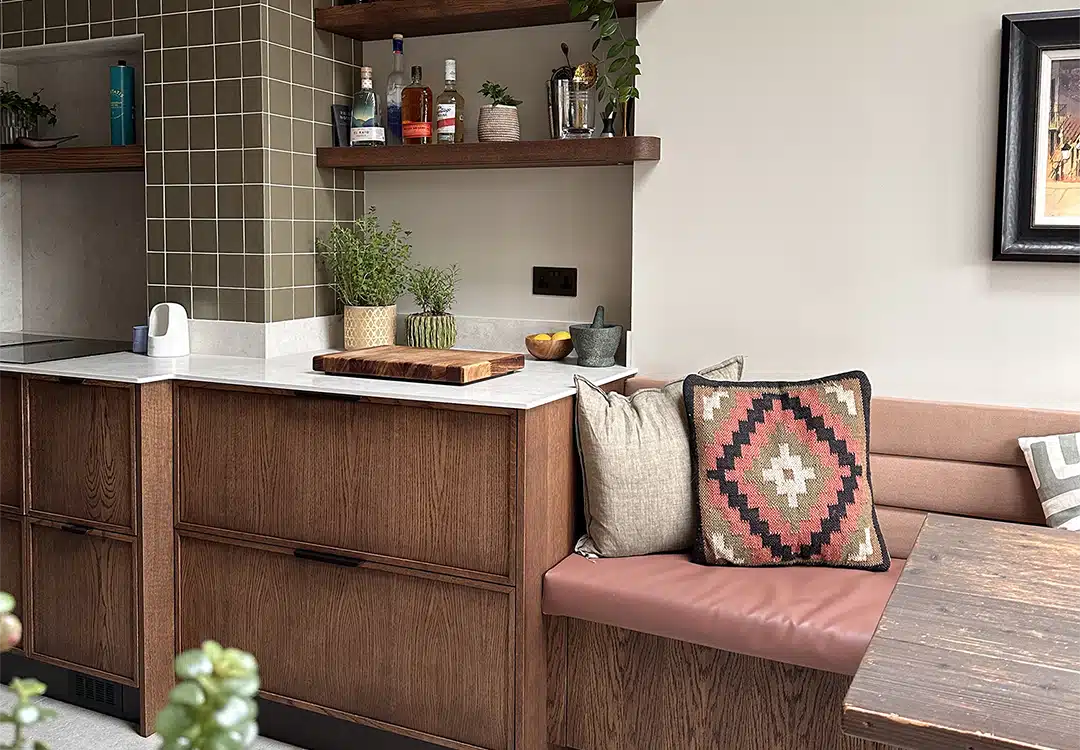
And I think that’s partly why the idea of a ‘soft kitchen’ interests me. The phrase itself might be new, but the idea really isn’t. Timber, colour, artwork, lamps, upholstery, old pieces of furniture and objects collected over time have always helped rooms feel more personal. It doesn’t mean throwing all of them into a kitchen at once; it’s about the choices that give you some kind of felt response – a piece of timber you want to touch, a colour that just sings to you, a tile you keep going back to for reasons you can’t entirely explain. That’s the stuff that starts to give a room character, not because somebody has decided it’s what kitchens should look like next year, but because you respond to it.
“Good design isn’t necessarily the kitchen that gets the most saves on Instagram; sometimes it’s the kitchen that makes one particular family’s life considerably better”.
What are we really looking for at home? //
There may be a bigger reason we’re thinking about all of this differently. The world feels pretty fast at the moment – complex, uncertain and occasionally rather scary – and your home is one of the few places where you have a considerable amount of control over what surrounds you and how it makes you feel.
It turns out I’m not alone in thinking that. IKEA’s latest Life at Home research found that the importance we place on security, comfort and control at home has increased over the last couple of years. Comfort now matters to 86% of people surveyed, while 74% place importance on feeling in control at home. B&Q’s research tells a similar story: 87% describe home as a sanctuary from the outside world, while 80% say they don’t want their space to look like everybody else’s.
Which makes me wonder whether some of these kitchen ‘trends’ are actually just the visible end of something much bigger. Maybe we don’t particularly want an invisible kitchen; maybe we want a home that feels more like ours. And because the kitchen has become the room where so much of life happens, that’s where we’re seeing the change most clearly.
Although let’s not get too carried away. For all this talk about authenticity, individuality and not caring what anybody else thinks, we’re still human. We still see things we like and want them: the beautiful pantry, the coffee station, the appliance garage, the enormous island. Perhaps we’ve simply moved some of the performance behind another set of very beautiful pocket doors. There’s definitely a bit of a ta-da moment when a beautifully designed breakfast cupboard opens – and I’m not judging that because I rather like a ta-da – but these spaces can also be genuinely useful, highly functioning parts of a kitchen.
IKEA’s 2026 research into cooking and eating found that only 32% of people are actually happy with their kitchens, with lack of storage and work surface among the biggest frustrations. So perhaps the problem isn’t that we’re all slavishly following trends; it’s when we start with the thing we’ve decided we’re supposed to have, rather than the problem we’re actually trying to solve.
Someone says they want an island. Fine – but why? They want a pantry. Great – what actually needs to go in it? They want an invisible kitchen. Do they? Or do they really want a room that feels warm and relaxed when they’re not cooking? Those conversations can lead to very different kitchens.
Choosing a kitchen, or designing one? //
And that’s where I keep coming back to the word bespoke. I don’t think it should mean taking a recognisable kitchen and allowing somebody to choose its dimensions, colour and materials. It should mean we’re allowed to start before we’ve decided what the kitchen is.
How do you live? Who uses the room? Where does everybody naturally congregate? What drives you mad about your current kitchen? What do you want hidden, and what do you actually enjoy looking at? Do you cook every night or mostly reheat something while pretending you’re going to cook tomorrow? Do you entertain? Do you work at the kitchen table? Are there children, dogs, or cats with absolutely no respect for the concept of a food-preparation surface? How do you want the room to feel at eight o’clock on a Tuesday morning, and how do you want it to feel at nine on a Saturday night?
Only then do we start deciding what belongs in it: fitted or freestanding, concealed or open, island or no island, pantry or no pantry, shaker doors or flat doors, timber or paint – or some combination nobody has thought of yet.
Because perhaps we’ve been starting the conversation in the wrong place. We talk about choosing a kitchen: choosing the style, choosing the colour, choosing the worktop, choosing the handles. But by that point, quite a lot has already been decided for us.
So, are we falling out of love with kitchens as we know them? I’m not sure we are. Maybe we’re just getting a little more comfortable with asking whether the kitchen we’re ‘supposed’ to want is the one we actually do want.
“Perhaps we shouldn’t start by choosing a kitchen at all. Perhaps we should start by designing it.”